Wildlife Photography Composition – Behaviour + Lighting

Wildlife Photography Composition – Behaviour + Lighting

A little tip for your wildlife photography composition:

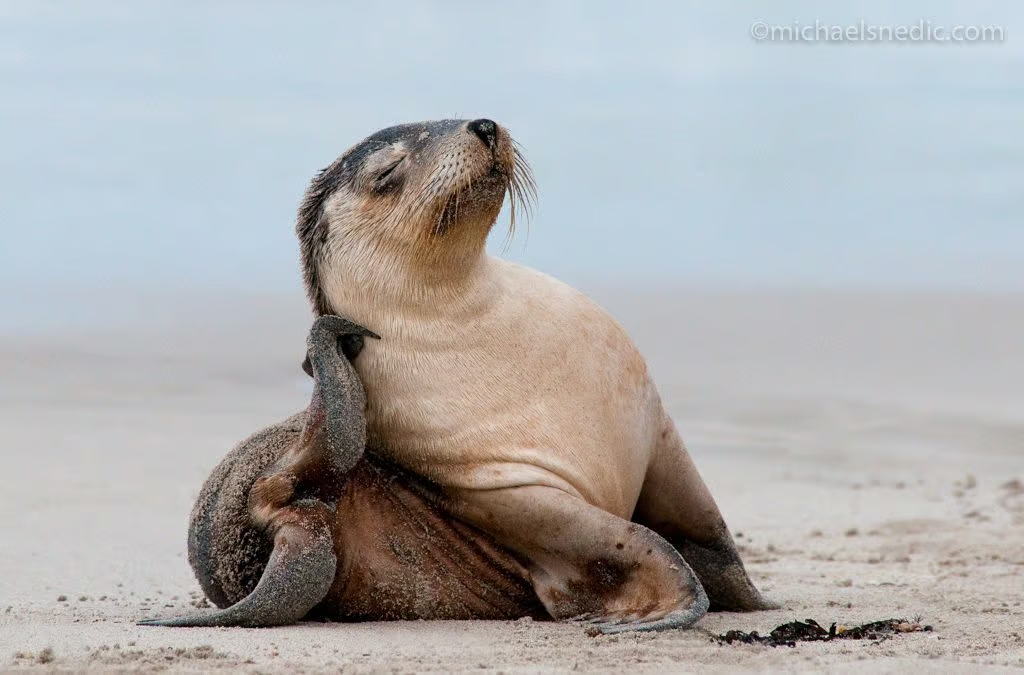
Australian Sea Lion

This juvenile Australian Sea Lion was photographed on the beach at Seal Bay, Kangaroo Island, in South Australia.  I was thrilled to have been given the opportunity to photograph this amazing species.  I was with a qualified ranger/guide and a small group of other people, watching some Sea Lions interacting around me, while others slept peacefully. They seemed totally unconcerned that there was a group of humans standing nearby.  Before I even took a photo, I observed their behaviour closely, watching out for any interesting behaviour to happen.  Nothing out of the ordinary did happen for a while until this juvenile came towards me and seemed quite “bouncy” and energetic….

Patience is one of the keys while you watch out for interesting behaviours and patterns. I’ve seen it time and time again and have written about it before.

I immediately focused my camera on the juvenile sea lion and composed my shot, waiting for something to happen.  After a few minutes of playing around, the Sea Lion finally turned in my direction and started to scratch.  This was my moment!  I recomposed my shot, focused on its eye and took several shots using the continuous shutter mode on my camera.  I ensured there was room in the direction the Sea Lion was facing, an important part of wildlife photography composition.  Fortunately for me, light grey clouds in the sky made for perfect, diffused light.  This type of lighting is preferred to sunny conditions, which tend to cause annoying highlights that blow out any light areas on your subject, as well as create harsh background shadows. Even when these lights are manageable, they can cause distraction from your subject. Diffused lighting is more consistent, ensuring that your subject stays the focus and not the light.

The Australian Sea Lion is Australia’s only endemic Sea Lion and is listed as a threatened (vulnerable) under the Federal Government’s Environmental Protection and Biodiversity Conservation Act.   It is Australia’s only endemic Sea Lion and their population is thought to be between 10 000 – 12 000.

It was a real joy to be able to spend time photographing this beautiful mammal, and an experience I thoroughly recommend to anyone.

Happy photography!

If you have a passion for African wildlife, nature or travel photography and would love to go on a specialised small-number, professional African photo safari, please get in touch with Michael Snedic at WildNature Photo Expeditions. You can call him on 0408 941 965 or fill in this Contact Form and he will get back to you ASAP.
Observation – The Secret to Capturing Great Wildlife Photos

Observation – The Secret to Capturing Great Wildlife Photos

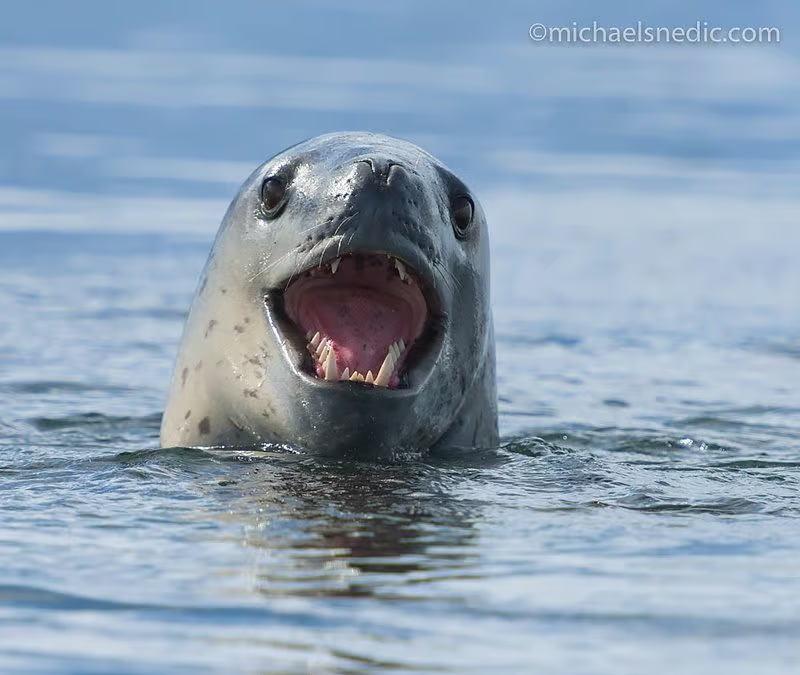
Leopard seal

Observing the individual beforehand is a major part of getting great photos of wildlife behaviour. Animals often behave in similar ways or have a pattern they follow, making it much easier to predict where they might go or what they might do. You can have the settings on your camera set, with your finger on the shutter button, ready to take the shot.

If you have an idea of what kind of animal you plan to photograph, you can read up on common behaviours in advance, which is helpful. However, there is no substitute for observing them at the moment.

In this example of a Leopard Seal in Antarctica, I had been observing it closely as I tracked it with my camera while it was swimming. It would swim for a while, then open its huge jaw briefly before closing it and swimming on. It repeated this pattern a few times, so I knew the chances of the seal opening its jaws again were quite high.

My camera was set up with a single focus point and continuous focus mode (or AI Servo for Canon users). I focused on the seal’s head, then half-depressed the shutter button while tracking the moving subject. When it opened its jaws, I hit the shutter button, which was set to ‘burst’ mode, making sure I captured all of the action.

Of course, it’s always prudent to maintain a safe distance from the animals you are photographing, especially if the animal is a wild predatory animal like a leopard seal. These magnificent creatures of the Antarctic only have two known predators, orcas and sharks, and they tend to be intrigued by humans. However, while you might not be much threat to them, they certainly are to you, so always be alert, minimise your presence (and disturbance) and stay safe.

If you have a passion for African wildlife, nature or travel photography and would love to go on a specialised small-number, professional African photo safari, please get in touch with Michael Snedic at WildNature Photo Expeditions. You can call him on 0408 941 965 or fill in this Contact Form and he will get back to you ASAP.

Use of Perspective In Wildlife Photography – Part One

Use of Perspective In Wildlife Photography – Part One

Polar Bear and Reindeers_980x669


Perspective can make a huge difference when photographing wildlife. Basically, it can change how an image is perceived. A three-dimensional view can be turned into a two dimensional image, by either changing your lens or using a different angle or viewpoint from which you are shooting your subject. You are, in essence, impacting how the viewer of the photo interprets depth in the image they are looking at.

Traditional Methods

Traditionally, most wildlife images are taken with a fixed focal length telephoto lens such as a 300mm f2.8, 500mm f4 or 600mm f4, or by using one of the numerous zoom lenses available on the market. Many of the more popular lenses used in traditional wildlife photography include 100-400mm, 200-400mm, 200-500mm, 150-600mm etc. There are, of course, pros and cons with any of the above-mentioned lenses. Telephoto lenses are usually very sharp and have a wider minimum aperture. This means you can let in more light into your camera, which in turn means a higher shutter speed without needing to crank up the ISO too high (the higher the ISO, the more noise you will end up with). The downside is that these lenses are quite expensive, heavy and if you can’t move from the spot you are photographing (such as sitting in a safari vehicle in Africa, with a lion in front of you) you can’t change your focal length. With a zoom lens, you have more option to compose an image on the spot, they are generally cheaper in price and a bit easier to handhold, weight-wise. The downside here is that they may not be as sharp as a telephoto lens and the minimum aperture will often be smaller in size. For example, the Sigma and Tamron 150-600mm lenses are very versatile but in low light scenarios such as rainforests, the widest aperture you can achieve at 600mm is f6.3. This then slows the shutter speed quite a bit so in turn you have to raise your camera’s ISO considerably in order to get sharp shots.

Animals In The Environment

Apart from the traditional longer telephoto and zoom lenses, you can use a variety of different lenses to achieve a completely different view. Many of the renowned wildlife photography competitions around the world include a category called ‘Animals in the Environment’, where the animal(s) are a small part of a landscape. This gives the viewer a chance to see the animal in its natural environment. Images where you first see an amazing landscape, then realise there is an animal(s) can be quite pleasing on the eye. For the image of the four reindeer and a polar bear in Svalbard, the Arctic, featured in this article, I was in a zodiac with my photography tour participants and I saw the gorgeous light bringing out the blue in the icy landscape. As we approached a little bit closer, I only then noticed the animals. The important part here was to use a small (in size) aperture, therefore creating greater depth-of-field. By using a lens with a smaller focal length, I was able to photograph the landscape as well as the wildlife featured within that landscape. This type of image creates a true sense of scale which may not be evident when photographing the landscape on its own.

If you have a passion for African wildlife, nature or travel photography and would love to go on a specialised small-number, professional African photo safari, please get in touch with Michael Snedic at WildNature Photo Expeditions. You can call him on 0408 941 965 or fill in this Contact Form and he will get back to you ASAP.

Wildlife Photography Composition Tips

Wildlife Photography Composition Tips

Baby Elephant Seal

1. Avoid Placing Your Subject in the Centre of the Frame

Many wildlife photographers, when beginning their photography, place wildlife directly in the centre of the frame. If at all possible, avoid doing this. Instead, compose your image so that the animal’s face is across the intersecting ‘rule-of-third’ lines. If you place the subject in the centre, it often forces the viewer’s eyes to stay on the subject, which can end up producing a very average image. By composing your subject off-centre, it makes for a much more pleasing image, as the viewer will tend to look at what else is surrounding the subject.

2. Shoot at Eye Level

From the very beginning, when I started learning about wildlife photography some 25 years ago, I was told by my photographic mentor to ‘shoot at eye level’. Rather than standing up and pointing your camera and lens down onto an animal that’s on the ground, get down as low as you can. Photographing wildlife at their level is so much more pleasing to the eye.

The same goes for shooting straight up at an animal. Its not always possible to get to their level, but by stepping back a few metres, for example, your composition will be so much nicer. In some cases, if there is a hill nearby or some steps, I suggest walking up the hill or steps so that you are on a similar level as the subject. One exception to this rule, is when there is a bird (or birds) flying above you.

3. Watch out for Distracting Backgrounds

Over the last 20+ years, I have judged thousands upon thousands of images in nature and wildlife photography competitions. So often, I have seen amazing wildlife images, only to be ruined by a very distracting background. If you look at an image and your eye goes straight to the distraction, rather than the subject, it ruins the effect you are trying to convey. By distractions, I am referring to things like man-made objects (buildings, fences, cars etc), bright highlights or blurred out trees and branches. In many situations, you can move around the subject until you have a smooth, blurred out background that doesn’t
compete with the subject.

If your subject is cooperative, I suggest shooting a few frames and then checking the images on the camera’s LCD screen. If a distraction pops out at you ‘like a sore thumb’, then change the angle or direction from which you are photographing. In some instances, if there is a distracting shiny leaf in the background, simply pick it up and move it out of the way. It’s much easier to do this in situ, rather than trying to clone out the distraction during post-processing!
(PS – many nature photography competitions don’t allow cloning of any sort, so best to move the distraction while you are physically out photographing).

4. Focus on the Eyes

One very important rule when photographing wildlife is to focus on the eyes of your subject. If the animal/bird is way out in the distance and tiny in the frame, then focusing on the actual subject is fine. But if you are closer, then it’s the eye that your camera’s focus point should be on. When viewing an image, whether it be online, in a publication or as a framed print, it doesn’t work as well if the eyes aren’t in focus. The first thing we tend to look at when looking at an image of an animal is the eyes, so it makes perfect sense to focus on them. In some instances, such as when you are photographing wildlife in an abstract or arty way, this rule doesn’t count but for most situations, it is very important.

5. Best use of Negative Space

An alternative to tight or close up shots of wildlife is the use of ‘negative space’ in wildlife photography. This is where the subject is a very small part of the image and looks out or is travelling across a vast landscape. In many wildlife photography competitions, the category ‘animals in the environment’ has become increasingly popular. The aim of such images is to capture on camera not only an interesting image of an animal, but also the environment in which this particular species lives. A stunning landscape, coupled with the subject, can make for some impressive shots. The space around the subject can greatly change the viewer’s perception of the image they are looking at. Basically, the negative space around a subject can tell the ‘story’ of the image.

In Conclusion

The best thing I can suggest is to get out there with your camera and try some of these techniques. Practise, try new techniques, then practise some more.

If you have a passion for African wildlife, nature or travel photography and would love to go on a specialised small-number, professional African photo safari, please get in touch with Michael Snedic at WildNature Photo Expeditions. You can call him on 0408 941 965 or fill in this Contact Form and he will get back to you ASAP.

Bird Photography Techniques – Avoid Cloning Same Backgrounds

Bird Photography Techniques – Avoid Cloning Same Backgrounds

Splendid Fairy Wren

I love seeing images of other bird photographers. There are plenty of shots posted daily on places such as Facebook and Instagram and it’s great to se such variety. There are some exceptional photographers out there but one thing I have noticed is the noticeable increase in bird images where the background has been either cloned out or ‘blurred’. Yes, it makes the bird(s) stand out but plenty of photographers are using the same peach/pastel backgrounds, rendering the images ‘more of the same’.

To do this occasionally is fine, in my opinion, but to do this for every single image can become quite monotonous. I have been teaching bird photography techniques for 17 years+ and have always taught participants to ‘get it right in camera’, out in the field. You can the process your image, of course, but by using a natural background that’s blurred out, it is a much more pleasing image.

In some cases, you can easily see a halo or white mark around the bird, where the cloning or blurring wasn’t done well. To me, that completely spoils the image. I have also seen where photographers have blurred the background and the blurred sections have been used multiple times and are identical to each other, something that again spoils the image.

Sure, there are definitely instances where the bird(s) are in a spot where you have no choice but to takes shots as is, regardless of the unsightly background. In those examples, you can work on your background on the computer, so that the bird doesn’t get ‘lost’ in the image. I, however, have NEVER cloned a background and it has always been my aim to work that bit harder to get it right, out in the field.

Removing a blade or two of grass or a twig is common practice in post, using the Spot Healing Brush and Content Aware Fill, in Photoshop, but the image remains as close to authentic as possible.

I must add that there is nothing wrong with cloning backgrounds out and replacing them, if that’s what you enjoy doing. It is, in the end, a personal choice. Just try not doing the SAME cloning/blurring for shot after shot.

Lastly, if you are entering nature photography competitions, please read the rules very carefully, as they vary from competition to competition. Some, such as Wildlife Photographer of the Year’ in the U.K., don’t allow any cloning whatsoever and you must provided the original RAW file on request, if you are selected for the finals.

In the end, do what makes you happy and feels right. I’m only suggesting you don’t become a ‘clone’ with every single image you process : – ))

 If you are interested in developing your bird photography skills, Michael has a two-day bird photography workshop coming up in the QLD Bunya Mountains.

If you have a passion for African wildlife, nature or travel photography and would love to go on a specialised small-number, professional African photo safari, please get in touch with Michael Snedic at WildNature Photo Expeditions. You can call him on 0408 941 965 or fill in this Contact Form and he will get back to you ASAP.

Best Wildlife Photography Locations in Australia: Yellow Water – Kakadu N.P.

Best Wildlife Photography Locations in Australia: Yellow Water – Kakadu N.P.

Kakadu Photography Workshop

Australia is a true haven for wildlife photography, with so many different types of habitats being home to a plethora of varied wildlife species. There are lots of different habitats for wildlife to thrive in: islands, beaches, rainforests, eucalypt forests, granite country, snowfields, desert and the outback, to name but a few.

Having been a specialist wildlife/nature photographer here for the last 24 years and having presented photography tours for the last 17 years, I have traversed much of this amazing continent, camera-in-hand. In this article, my aim is to show you some of the BEST wildlife photography locations and experiences Australia has to offer.

Yellow Water – Kakadu National Park – Northern Territory

One of the most incredible bird and wildlife experiences in Australia can be found at ‘Yellow Water’, situated in Kakadu National Park in the Northern Territory. The unbelievable variety and number of birds (over 280 species) is truly breathtaking and many species such as the Comb-crested Jacana can be photographed at quite close range. Reptiles include Saltwater Crocodiles in large numbers (they can be photographed from the safety of a boat), as well iconic reptile species such as the Frill-necked Lizard, monitors and various other lizards and geckoes. Mammals species include the dingo, Northern Quolls, Agile and Short-eared Rock Wallabies as well as Bandicoots.

There are plenty of boat trips that cruise Yellow Water daily, where you will get to see and photograph wildlife to your heart’s content!!

Yellow Water is approximately 300kms from Darwin (Northern Territory capital). You can either hire a car and drive or book one of the buses that drive there direct.

If you have a passion for African wildlife, nature or travel photography and would love to go on a specialised small-number, professional African photo safari, please get in touch with Michael Snedic at WildNature Photo Expeditions. You can call him on 0408 941 965 or fill in this Contact Form and he will get back to you ASAP.

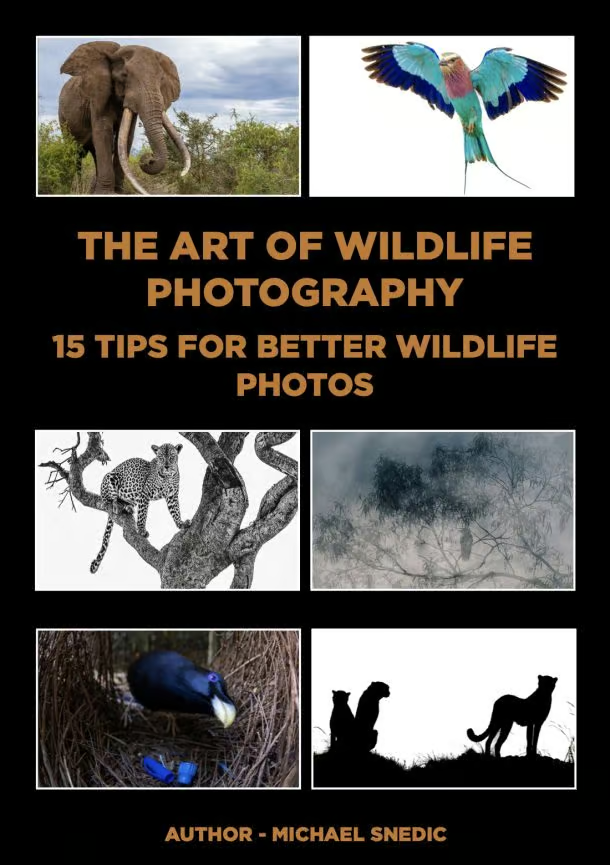
Would you like a FREE copy of my new Ebook?

Download Button

Would you like a FREE copy of my new Ebook?

You have Successfully Subscribed!